AMYOTROPHIC LATERAL SCLEROSIS
The neurotoxins which Borrelia burgdorferi produces can cause extensive neurological dysfunction in the central nervous system and, as a result, symptoms which are typical of amyotrophic lateral sclerosis. The most important symptom of
ALS is neuron degeneration which may lead to the patient’s death. Studies by Dr. Harold Clark and Dr. Garth Nicholson, also coordinated by Donald W. Scott, have led to a breakthrough in our understanding of amyotrophic lateral sclerosis. The story begins with the discovery of mycoplasma in 1898. Mycoplasma are living bacteria, nucleic acid particles, which do not have any cell membrane at all. M. Rottem et al. discovered in 1971 that mycoplasma are completely dependent on various early forms of steroid to grow. This contains cholesterol, amongst other things, obtained from animal and also human cells. These mycoplasma live quite harmlessly in their host cells until stimulated to become active by a traumatic event, e.g. a gunshot wound, an injury sustained in an accident or similar. I also include emotional trauma here.
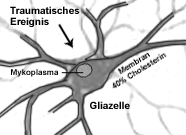
When the mycoplasma start to grow, they will consume the cholesterol of the host cell until it dies. Mycoplasma have always been identified in ALS. In the 9 November 2001 issue of Science, Dr. Daniel Mauch et al. published that the glia cells of the neurons responsible for the motor system produce the extra cholesterol needed to repair and replace the ageing synapses. If this repair process is incomplete, the neuron cells begin to die as they are overworked.
The glia cells are also heavily involved in collecting, processing and storing glutamate. Raised glutamate levels have always been found in the brain cell clusters of ALS patients. One mycoplasma species, probably M. fermenta, which initially penetrated the glia cells quite harmlessly suddenly becomes active after a traumatic event. The mycoplasma begin to consume the cholesterol of the glia cells. Incidentally, this makes up 40 % of the membrane of the brain cells. And this causes the glia cells to rupture and die. The death of the glia cells, in turn, releases large amounts of glutamate which becomes raised in the brain membranes. This abundance of glutamate within the neurons combines with uric acid molecules. This urine molecule will then release an ammonium ion which converts the glutamate molecules into less dangerous glutamine. However, this urine molecule remains as a cyanate ion and this will, in turn, damage the mitochondria of the motor neurons. (Hence the use of ornithine and arginine which, as is well known, are able to untie the uric acid molecules in the brain).
- Mycoplasma activated
- consumes the cholesterol of the glia cells
- glia cells rupture and die
- glutamate levels in the brain membrane raised
- glutamate and uric acid molecule release ammonium ion
-
glutamine and cyanate ion cause
- damage to the mitochondria in the motor neurons
- lack of energy, weakness and tiredness
- neurons die off → no information to the muscle membranes → ALS
The consequence of this damage to the mitochondria is that this cell can no longer produce energy to be supplied to the neuron. This leads to the extreme weakness and tiredness also seen in patients with chronic fatigue. If the injury to the mitochondria is very extensive, the neuron will die. If the motor neuron dies, information will no longer be passed on to the muscle membranes and this is the overall symptom of ALS.
So this high cholesterol consumption may also explain the general hormonal dysfunction always seen with ALS if the cholesterol needed to produce oestrogen, testosterone, progesterone, hydrocortisone and aldosterone is too low. Patients with ALS, fibromyalgia and chronic fatigue very often have hypothalamic dysfunction and this, in turn, causes adrenal insufficiency, hypothyroidism and gonadal dysfunction.
SUPPLIERS AND INFORMATION
- Samento (Cat’s claw) / DermaVit
- Orthomolecular substances / DermaVit
- Impulse generator 3.6 + 1550 Hz / Regumed
- Parasite test set Dermavit / Regumed

